Equipment evaluation guide
For small and medium oil processing plants, an automatic oil press should be evaluated as part of the complete production process—not only by its advertised pressing capacity. Qi'e Grain and Oil Machinery Co., Ltd. develops oil pressing and processing equipment for businesses that need practical integration of pressing, filtration, labor organization, and day-to-day operation.
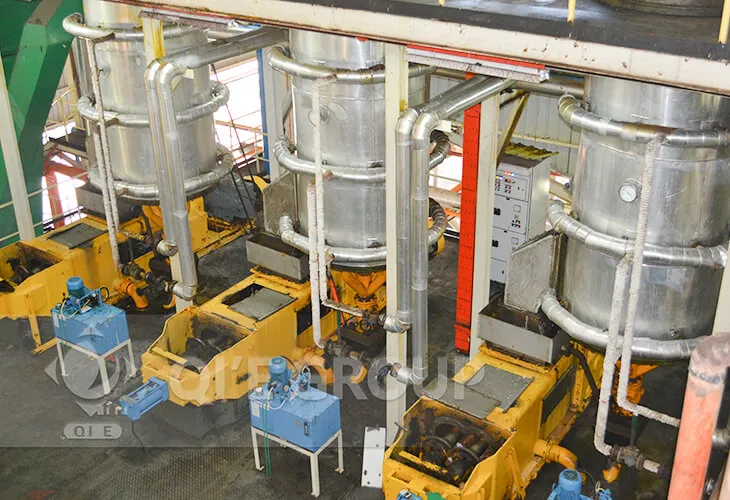
An integrated automatic oil press combines screw pressing with an oil filtration system in one processing unit. Oilseed material is fed into the hopper, conveyed through the pressing chamber by a rotating screw, and subjected to progressive pressure. The extracted crude oil is then filtered through the machine’s filtration system while pressing continues.
This configuration can simplify the workflow for small and medium oil plants by reducing the need to transfer crude oil between separate basic processing steps. However, automatic filtration should not be confused with complete edible oil refining. Depending on the oilseed, product specification, and local requirements, additional refining processes may still be necessary.
A screw shaft moves prepared oilseed through the pressing chamber. Pressure and friction help release oil from the material, while the solid residue exits separately.
The machine uses filtration devices and oil-guiding technology to remove suspended particles from the extracted oil during operation.
A forced feeding device is designed to support more uniform material entry and continuous operation, subject to suitable preparation and operating conditions.
A reliable evaluation should combine technical, operational, commercial, and regional factors. The following framework can help buyers compare an automatic oil press with other equipment options.
| Evaluation area | Questions to ask | Why it matters |
|---|---|---|
| Processing capacity | Does the actual throughput match the planned daily or hourly production volume? | Undersized equipment can restrict production, while oversized equipment may increase investment and operating complexity. |
| Oilseed compatibility | Can the press process the intended crops, such as peanuts, soybeans, rapeseed, sesame, or sunflower seeds? | Different oilseeds require different preparation, moisture, temperature, and pressure conditions. |
| Oil yield | What oil extraction rate can be achieved with the buyer’s raw material and process settings? | Yield is affected by seed variety, moisture, pretreatment, pressing method, and operator adjustment. |
| Filtration performance | How is filtration integrated, and what oil clarity is required for the intended product? | Filtration supports crude oil cleaning, but it does not automatically provide every refining function. |
| Energy and labor | What power supply, staffing level, and operating schedule are available locally? | The business case depends on energy prices, labor availability, utilization rate, and maintenance practices. |
| Installation and support | What space, utilities, training, spare parts, and technical support are required? | Installation conditions and after-sales support directly influence startup time and long-term operation. |
Process note: Heating, moisture control, pressing pressure, and feed consistency influence oil extraction efficiency. Actual results should be confirmed through raw-material testing and operating trials rather than assumed from equipment specifications alone.
Pressing and basic oil filtration are arranged within one equipment workflow, which can simplify handling between process stages.
The equipment is described for use with several oil crops, including peanuts, soybeans, rapeseed, sesame, sunflower seeds, and other suitable materials.
The stated space requirement of approximately 10–20 square meters may suit selected small-scale production layouts, subject to plant design and local safety requirements.
Automatic feeding and filtration can help reduce repetitive manual work when the machine is correctly configured and operated.
Qi'e Grain and Oil Machinery Co., Ltd. describes the automatic oil press as a solution intended to improve process integration and operating convenience. Its product information indicates that, under stated comparison conditions, the machine may reduce electricity use and labor requirements while improving oil yield. These figures should be treated as reference claims for evaluation, not guaranteed results for every plant.
The suitability of an automatic oil press varies by market. In Asia, Africa, and South America, buyers may have different oilseed supplies, power conditions, labor costs, food regulations, and consumer preferences. A practical assessment should therefore consider:
An integrated pressing and filtration automatic oil press may be a suitable option for small and medium oil plants seeking multi-seed processing, reduced manual handling, and a compact production arrangement. The right choice depends on verified capacity, raw-material compatibility, oil-yield expectations, filtration requirements, operating costs, local regulations, and available technical support.
With experience in oil pressing equipment, oil production line equipment, and edible oil refining equipment, Qi'e Grain and Oil Machinery Co., Ltd. can support buyers in evaluating equipment configuration, installation needs, and technical service requirements for their intended market.
 45
|
 edible oil processing equipment oil pressing equipment oil extraction equipment edible oil refining equipment Qi'e Grain and Oil Machinery Co., Ltd.
86
|
edible oil refining equipment degumming and deacidification decolorization and deodorization refining process Qi'e Grain and Oil Machinery Co., Ltd.
499
|
oil press equipment purchasing grain and oil machinery supplier equipment total lifecycle cost installation and commissioning service Qi'e Grain and Oil Machinery Co., Ltd.
252
|
edible oil production line equipment oil pressing equipment oil refining equipment grain and oil processing project Qi'e Grain and Oil Machinery Co., Ltd.
342
|
overseas project complete line delivery installation and commissioning project implementation Qi'e Grain and Oil Machinery Co., Ltd.